
When I first began this blog, I did not anticipate that my struggles with my health and my diet were going to be quite as extreme as they have been. Neither did I expect the Bible Study effort to be so all-consuming. Do not get me wrong. I fully anticipated that both of these aspects were going to be exceedingly difficult to handle, yet they both turned out to be far greater challenges than I expected.
I knew that the battle with my gastrointestinal affliction was going to be exceedingly difficult. After all, I have been battling with this affliction for 20 years. I knew that it was going to be insanely difficult, but I had no clue that, in the process, I would be uncovering this long-standing body-fluid balance issue. The whole situation has been a huge surprise to me. It is an incredibly complex problem, and it is not a situation that can be resolved quickly by any means.
With the Bible study, it just never occurred to me that the beginning of the Scofield Bible would contain so many comments to grapple with, as well as comments of such complexity and depth. With the Scofield Study Bible, well over 10% of all the comments in the entire Bible are contained in the book of Genesis. Moreover, some of the most complex and comprehensive comments that Dr. Scofield includes in his Bible are situated in the first half of the book of Genesis. Therefore, the effort to produce these Bible studies, here at the beginning, has been about three times as great as what I anticipated.
As a result, I have had no choice but to completely neglect the care and feeding of my blog, and, more importantly, I have not been able to focus my attention on you as I feel that I should. As I stated in my most recent blog post, “The Waiting Drives Me Crazy,” God has let me face these difficulties for very definite purposes. There are reasons why these difficulties have come about, and they are very good reasons. Furthermore, they are all reasons that need to be explained; however, I cannot explain them to you until you understand more about the quest itself.

Now that this time has arrived where I have such a need and a dependency to provide to you more specific details about the quest, it will also serve to satisfy the long-standing urge that I have had to write about these things. These are the things that I have been wanting to write about since the very beginning. Thus, without further delay let us get started.
We have already established the fact that the starting point for the quest is in Singapore, and when I begin my journey in Singapore, I will be traveling to Australia by way of watercraft. I have already explained a few details about this special watercraft in my blog post to you, titled, “Our Shelter.” It was, at that point, that I began to refer to it as an “ark,” as opposed to a boat. The reason why is that it is so much more than just a boat.

The most significant aspect of the “ark” is the shelter that it provides for me on land, on the ice, and in the water. Additionally, it provides all of the lading for my entire journey, all of my food, all of my supplies, and all of my equipment. On the ice and snow it operates as a sled or as a pulk, and on land it operates as a trailer. In all three scenarios, I tow it behind my cycle, or if the terrain is too extreme, I can pull it as I traverse by skis or by snowshoes.
However, it is a whole lot more than just a container. It is not merely a shelter for my own body, it is a thermal management system for all the supplies and equipment that I carry. It can keep me warm even when the temperatures fall as low as 70° or 80° below zero (-57° or -62° Celsius). It keeps my frozen items frozen. It keeps my perishable items and my water from becoming frozen during extremely cold weather. It keeps my batteries and electronics from getting too hot or getting too cold. The ark is not just a craft. It is a system, or rather, it is a collection of integrated systems, including all of my communications and media systems. To say that it is high tech is somewhat of an understatement.
This is why the materials and the design of the ark are so critically important. The hull design of the ark is based on a type of boat known as an expedition wherry. A small wherry is somewhat of a cross between a typical rowboat and a sculling shell. A standard wherry has an open hull much like a standard canoe. An expedition wherry is outfitted with compartments to protect the craft’s lading from stormy elements and rough seas. However, the ark that we are building for this quest is unlike any other expedition wherry ever built. Really, there is no boat that has ever been built that is anything like it. It is more like a space capsule than anything else.

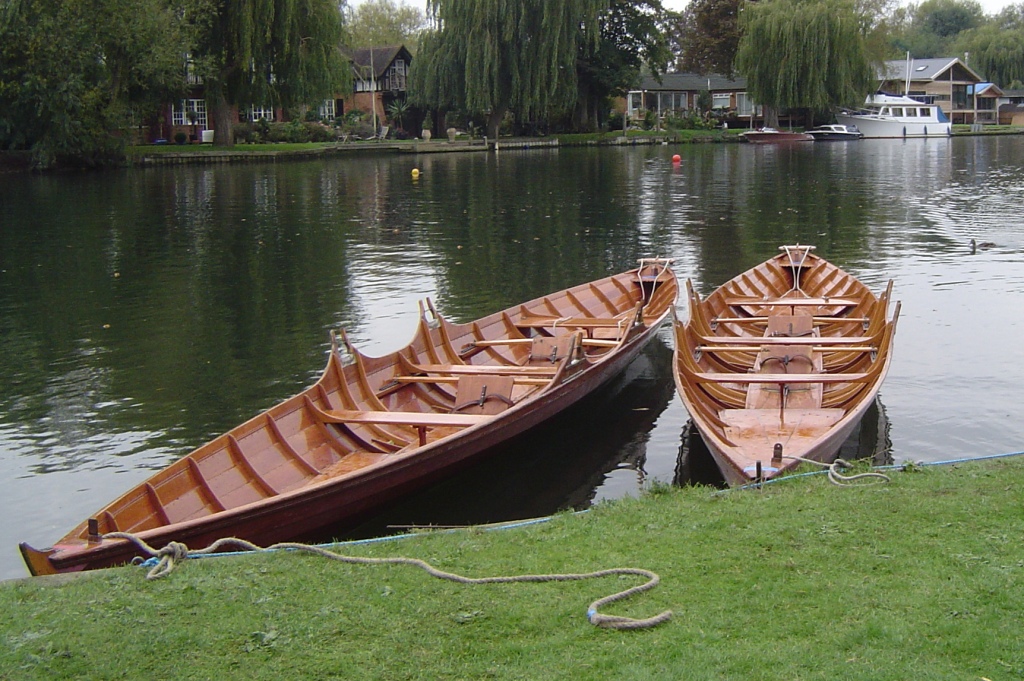

(at Design Museum), 2011
From Singapore, when I embark on my journey, the current expectation is that the ark will be laden with somewhere between 250 and 350 pounds of supplies and equipment (113 kg to 158 kg). Therefore, the ark with all the supplies and equipment is expected to weigh in between 400 and 500 pounds total (181 kg to 227 kg). From Singapore I will row directly to Denpasar, Bali, with very few stops in between.
On the leg from Singapore to Denpasar, Bali, Indonesia there are numerous places where I could stop for supplies, rest, and reprieve. However, the ark and the outfitting of the ark need to be proved and tested, as it will be new, having never been put to the test before. If the ark can get me from Singapore to Denpasar, then we will have more assurance that it will get me from Denpasar to Australia. This is why I want to avoid making any stops for supplies in route from Singapore to Denpasar.
When I arrive in Denpasar, I will come in on the west side, and I will stay there for a few days. After stocking up on supplies and getting some rest, I will cycle across the island to the east side, get back into the ark, and embark on the next leg of the journey to Cable Beach, Australia.
The leg from Singapore to Denpasar is the first leg of the first stage, so that would be Leg 1 of the South Pacific Stage. The leg from Denpasar to Cable Beach is Leg 2 of the South Pacific Stage. Each leg of the journey is also further broken up into segments. For instance, The short 6 mile bike ride from the west side of Denpasar to the east side constitutes Segment SPAC1F. However, the second leg where I row from Denpasar to Cable Beach is also a single segment unto itself, Segment SPAC2A, which is approximately 783 miles (1260 km). The first leg is approximately 1080 miles (1738 km); therefore, the South Pacific Stage is about 1863 miles in total (2998 km). If everything goes perfectly and the weather is favorable, it should take approximately 15 days to row from Singapore to Denpasar and another 12 days to row from Denpasar to Cable Beach.
It is well to note that, whenever I land my boat, I will not always be able to pull it up on a nice sandy beach. There will often be times when I need to hoist it up onto a dock or to a ledge of ice. It does not matter how big and strong I might become, there’s no way that I will ever be able to lift a 500 pound (227 kg) boat out of the water onto a ledge of ice. Therefore, what I need is a portable rig to hoist my boat out of the water, but that adds more gear and more weight to my ever-growing pile of equipment.
Oh! But glory be to God! He has blessed me with a solution to this problem. One of the components of my ark is what is called a “rowing frame.” The rowing frame is the frame that the oars attach to, as well as the sliding seat and the platforms for my feet (foot boards). The solution to this problem is that all of these components are assembled from the same interchangeable parts. The oars, the rowing frame, the bike, the boat trailer, and the hoist can all be assembled from the same parts. Hence, I do not need as many parts as I would if I carried each of these pieces of equipment as whole pieces. Using this method of design, we are able to reduce the combined weight to nearly half of what it would be with a conventional design.
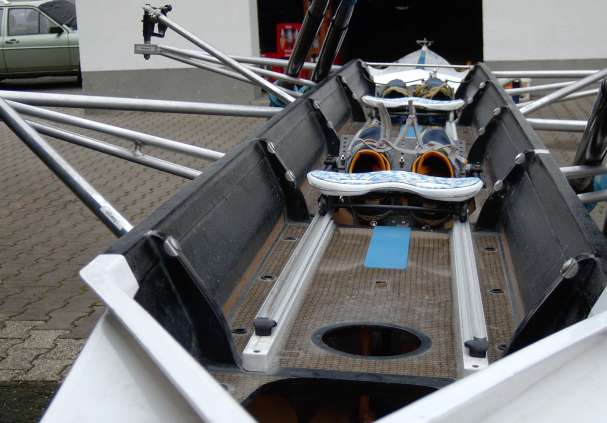
Everything is built into or off of the shell of the boat.
Here is how it works. When I land my boat, I disassemble the rowing frame then using many of the parts from the rowing frame and from the oars I am able to assemble the hoist. Then I hoist the ark out of the water onto the land or the ice. Finally, I disassemble the hoist and I use the parts to assemble the boat trailer and the bike. After I get the ark on the trailer, then I am able to handle the significant amount of weight with greater ease. This is important, because when I get to Australia, I will have no shortage of rough terrain and hundreds of miles of dirt roads that I must traverse.
Australia constitutes a single leg of the quest; however, it is made up of six different segments. With four of the segments I travel via land, and with the other two I travel by water. The first two segments (AUST3A & AUST3B) take me through the harsh and barren desert wilderness of central Australia, a combined distance of 1961 miles (3156 km). Then I have a relatively short segment of 64 miles (103 km) by water from Port Wakefield down the gulf of Saint Vincent to Adelaide (Segment AUST3C). From there I traverse 595 miles (958 km) to the east across the southern coast of Australia to the Tidal River in Victoria (Segment AUST3D).
Then I have another 142 mile (229 km) segment by boat from the mouth of the Tidal River to the northern side of Tasmania (Segment AUST3E). Finally, I have a road segment of 193 miles (311 km) from East Beach, Low Head, Tasmania to Port Arthur (Segment AUST3F). Therefore, the Australia Stage (Leg 3), in all, is a distance of 2958 miles (4760 km), 2752 miles (4429 km) by road and 206 miles (332 km) by water, a total duration of 35 days not counting any periods of rest or other delays.
It is from Tasmania where the fun really begins! The Southern Ocean Stage, 2628 miles (4229 km) across frigid and stormy waters to the frozen land of Antarctica!
The first leg (Leg 4 of the quest) of the Southern Ocean Stage Is a row of 928 miles (1493 km) from Tasmania to a little island on the edge of the Southern Ocean. About midway between Tasmanian and the eastern side of Antarctica there is an island by the name of Macquarie Island, where the Australian government maintains a research station for Antarctic exploration. This is where I will be landing at the end of this leg (Segment SSEA4A).

If it were not for the recent successful crossing of the Drake Passage by Fiann Paul and his crew (as I mentioned in “The Difficulty of my Errand”), I would consider this Leg 4 to be categorically impossible for anyone. Yet now, in light of Fiann Paul, it seems almost plausible for someone who is highly experienced and very well prepared, but for me it is still completely impossible. It is suicidal!
Nevertheless, Leg 4 is mild in comparison to Legs 5 and 6. Leg 5 strikes more fear in my heart than any other leg of the journey. It is 20 miles (32 km) from the north end of Macquarie Island to the south end (Seg. SSEA5A), and then from there it is 802 miles (1291 km) across the teeth of the Southern Ocean to the Balleny Islands, off the coast of Antarctica (Seg. SSEA5B). If the weather were pristine and everything were to go perfectly, I might be able to make it in as little as 13 days, but weather in that part of the world is rarely if ever pristine. I think that 30 days or even 50 days is a more realistic timeframe to make this passage.
When I finally get to the Balleny Islands, I am sure that I will be happy, but there is not a lot about the Balleny Islands to rejoice in. From what I am able to determine, the shorelines are all very abrupt and rocky. I suspect that it will be quite a challenge to find a place where I can land my boat and get it up on to shore. And besides that! When I do get to the Balleny Islands, I will simply be that much further in the middle of nowhere! There are a few places in the world that are more inhospitable, desolate, and as far away from civilization as these Islands.
To begin Leg 6, it will take me a few days to get from the northern end of the islands to the southern end (Seg. SSEA6A), 118 miles (190 km), and from there I travel straight to Cape Adare, 290 miles (467 km). Perhaps these waters will not be quite as foreboding as the Southern Ocean, but the temperatures are more likely to be much colder. To make this segment (SSEA6B), I am looking at no less than five days.

The final segment (SSEA6C) of Leg 6, which extends from Cape Adare to McMurdo Station, is where things get really interesting. This segment traverses the outer portion of the Ross Ice Shelf. Depending on what time of the year I arrive, I may run into frozen seawater even before I get to Cape Adare. The problem is I cannot row across frozen seawater.
When I encounter such ice, the first thing I must do is to find an ice ledge that will lead me to a smooth upper surface and that is low enough for me to be able to hoist my ark up onto the ledge (or a step up to the surface). What do I do once I get the ark up onto the surface of the ice sheet? Is there a long enough run to make it worth my while to put the ark on skis? … or do I simply drag the boat across the ice like a pulk? Then when I get to the opposite edge of the ice sheet, I must get my boat back into the water and continue on to the next ice sheet.
The big question is, “How many times will I have to do this until I manage to get to the contiguous ice shelf?” … 5 times? … 20 times? … 100 times? For all I know, it could take me a month to go from navigable water to contiguous ice. How brutal would that be?!
If I hit it at the right time of the year, I could row all the way from Cape Adare to the docks at McMurdo Station, but if my timing is bad, the transition from water to ice could be essentially impassible. Additionally, the more disrupted and extensive that the transition happens to be, the more dangerous it will be. The likelihood of being crushed by rolling, breaking, or moving blocks of ice increases with each passing hour that I must spend traversing such terrain.
This is the primary reason why the hoist is so important. It is imperative to be able to make that transition from water to ice as quick and efficient as possible. Let us say that I am going to have to make that transition 25 times, then let us suppose that when I get to the other side of Antarctica, I have to repeat this process another 25 times. If it took an average of an hour to get my boat in and out of the water, that would be a total of 50 hours, and I would burn somewhere in the neighborhood of 40,000 calories in the process. That is nearly 20 pounds (9 kg) of food, just for getting my boat in and out of the water! But what if the average time for each transition was two hours?!
Whatever the case may be, I most likely will not be able to handle much more than about 350 pounds (158 kg). Even if I have a very effective and efficient hoist, I am limited by how much weight I can tow with my cycle. Any mountaineer or cold-weather explorer that is reading this would be able to tell you that even 300 pounds (136 kg) is far too much weight to pull on the snow and ice, without a team of sled dogs. However, here is yet one more instance where God has blessed me with a solution to a big problem, and with His solution, a 300 pound payload becomes more feasible.
With that weight restriction, I cannot expect to be able to carry more than a 50 day supply of food. That should be sufficient if my plan is to restock my supplies when I arrive in McMurdo. The problem with restocking supplies in McMurdo is that it adds an exception to the claim of “unassisted circumnavigation.” What if God wants me to continue on, without restocking my supplies in McMurdo, all the way to Palmer Station on the other side of Antarctica? If that is the case, then a 50-day supply of food is not much food at all!
That notion aside, a 50-day trek from McMurdo to Palmer Station is very ambitious. I do not know that there is anyone of this expertise that would consider such a feat to be possible. Following my current route selection, it is approximately 854 miles (1374 km) from McMurdo to the South Pole (Leg 7). My current estimate puts Leg 7 at a minimum of 30 days. However, the distance from the South Pole to Palmer Station is about twice that distance. As you can see, 50 days of food is not enough! Nevertheless, if I were not using coconut oil as my staple and I was using the conventional approach of provisioning my food supplies, I would only have about a 30-day supply of food for this stage of the journey. 50 days is a lot closer to where I need to be than 30 days!
I would love to delve more into detail here, but that would be getting away from the point of this post. The point is, even if I were five times as intelligent as I am, I could spend an entire lifetime trying to solve these problems and never arrive to any usable solution, despite the cost. Every aspect of this quest is so far beyond my understanding. I can only hope to solve the smallest and most mundane of the problems that I encounter. God is the only one who can provide solutions for the lion’s share of these problems, and this is the way that it has been since the very beginning.
This is the reason why I assumed that going through the 27.88 day fast that went on would provide a more immediate solution to my gut problem. I was severely lacking in my understanding. I am doing the best I can to follow the direction and the leading of an infinitely intelligent and all-knowing God, the God of all heaven and Earth. The fast was only part of the process. It was necessary in multiple ways, some of which I have already mentioned in my Fasting Status log. Yet, one of the things that I could not see was this whole body-fluid balance (cytosol/ICF, ECF, & osmoregulation) and lactic acidosis problem that I have.
Until I was well into the recovery process from my extended fast, I did not truly understand how extensive and impactful this problem really was. I always figured that the problem would work itself out after I was fully recovered from my gut problem, but that is not the case. It is a much bigger problem than I could have ever imagined. Had I not gone on the fast, I would never had come to that understanding or, at least, not until it was too late. God had to teach me, and the only way that I could reach that point of understanding was to go on a long fast — acting as a prerequisite for the conditions of the recovery scenario that would reveal the fluid-balance problem to me in a way that I would recognize it for what it really was.
If I had been delivered from my gastrointestinal affliction as I had supposed, then the underlying fluid-balance problem would still have been present as I moved forward with the quest. That would not have been good at all! It is far better that I have had to deal with these symptoms of hyponatremia here in the comfort of my home rather than if I were in my training boat in the middle of the Pacific Ocean or on a mountain side in Montana during one of my proving ground exercises. I would be a dead man if such a bout of sickness were to take hold of me in such a remote location. I would be finished before I ever made it to the starting line. Incredibly, this is only one of several reasons why God continues to lead me through this gauntlet of health issues.

Ultimately, God is teaching me the things that I need to know for a challenge that is sure to push my body to the very limit. He is causing me to understand how to prepare and to develop the systems that are required to provide for my body’s needs. These systems include, but are not limited, to: body fuel supply (involving, the optimization of fats, carbohydrates, and convertible proteins best suited for maximum sustained energy); the supply of essential nutrients (vitamins, minerals, electrolytes, amino acids, specialized sugars, enzymes, phytonutrients, triglycerides, polyphenols, and the host of other important elements involved in the numerous pathways of the human body); the recipes required to get these nutrients in my body in the most efficient; effective, and convenient way possible; the means to prepare and consume these meals; the storage systems needed to keep these ingredients fresh and organized, in the most compact and light weight forms as can be; and the systems and methods to keep everything clean and free from spoil and waste.
I do not know how to accomplish all of these things. I do not even know where to begin, but God is showing to me the things that I do need to know, and He is providing the rest of the details for those things that I do not understand. It is a good thing that He is, because it is all far too complex and overwhelming for me.
I know that at some point He will provide help for many of these things that I must currently take care of myself, but in the meantime, God has a great deal to teach me. He is not ready to ease my burdens until I have a better understanding of how the basic operation of everything is supposed to work. More importantly, He is not ready to ease my burdens until I learn to suffer. I have no lack of suffering ahead of me on this journey around the Globe, and it will not serve God’s purpose, my purpose, nor your purpose if I am not able to endure the trials that lay before me.
I made an oath with God that I would do anything for your sake, and now He is preparing me so that I am able to make good on that promise. Does that help you understand how truly great God’s love is for you? He is preparing someone who has already been through plenty of suffering in life to take on even greater suffering, just for the purpose of showing you how much God loves you! God is continually renovating and expanding my heart to love you in ways that I never knew were possible! … in ways that I never knew existed! He is doing all of these things for you my dear friend! For you!

Mr. Trussell,
I’ve read your recent post called, “Science is Wherry”
My comments will be short for now.
I know, as I’m sure you do too…
God will never ask You to do something without providing a way to accomplish it.
Saying that; Your plans are daunting and a considerable challenge. Even if you were 25 years old and an Olympian, this would be difficult.
So… I need to pray on this one.
Since I will be driving to SoCal the day after tomorrow, I will wait until my return next Sunday to ask God to help me understand more.
Even in deep faith, your Wife and Mother will struggle with the gravity of this circumnavigation.
I’m understanding why you’re overwhelmed.